
Flared, Burned or Sold: McKenzie County, North Dakota Gas Royalties
MINERAL RIGHTS & ROYALTIES
What could your mineral rights be worth?
Tell us a little about your interest. Get a free, no-obligation review from Selling My Mineral Rights.
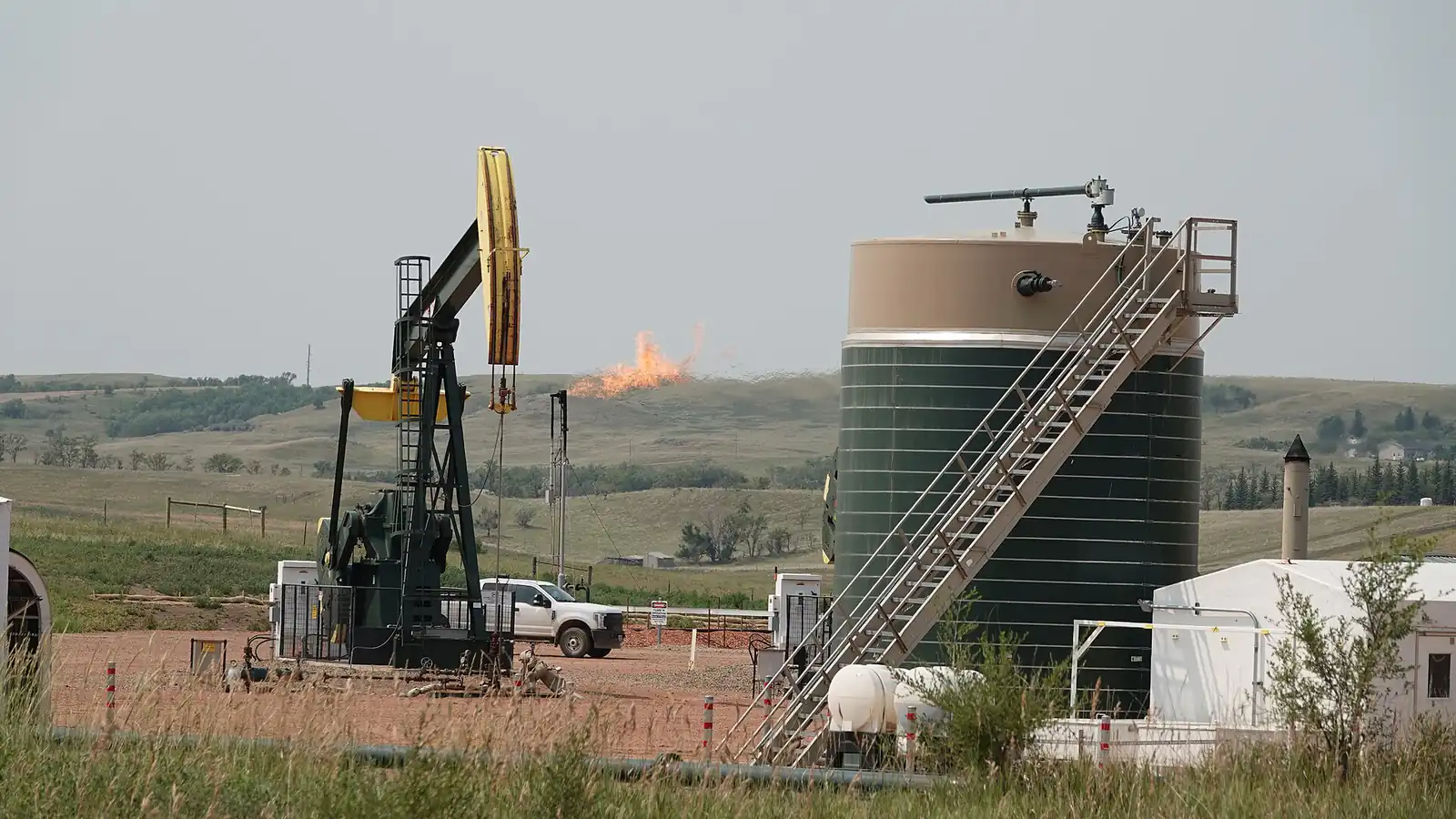
If you own minerals in McKenzie County, North Dakota, you have probably watched a flare burn on the horizon and wondered whether you are being paid for it. State law gives an operator several lawful ways to handle the gas that comes up with Bakken oil, and only some of them put money on your check. Knowing which is which tells you more about your interest than any rule of thumb about dollars per acre.
Your Bakken oil royalty is, in large part, a gas royalty
McKenzie is the largest producing county in the state, and disproportionately a gas county. In August 2026 it produced about 12.0 million barrels of oil, roughly 33 percent of North Dakota’s total, and about 51.8 million Mcf of gas, roughly 46 percent of the state’s, from 5,929 producing wells. That is about 4.3 Mcf of gas per barrel of oil. Statewide the figure was about 3.1.
That ratio climbs as a Bakken well ages. The oil line on your statement falls along a steep decline curve while gas and natural gas liquids hold up longer and become the larger share of the revenue. What happens to the gas stream is not a footnote to your royalty here.
Four things can happen to that gas, and only one reliably pays you
Trace a single Mcf of associated gas from a McKenzie wellhead and it ends up in one of four places.
- Sold into a gathering line. The case where you are paid. The gas goes to a plant, is split into residue gas and natural gas liquids, and the proceeds flow back through your decimal, less taxes and whatever post-production costs your lease permits.
- Burned on the pad in an electrical generator. A lawful alternative to connecting under N.D.C.C. 38-08-06.4(2)(c) if the generator consumes at least 75 percent of the well’s gas. Most lease forms pay royalty on gas sold or used off the premises, so gas burned on the lease commonly carries no royalty. The state takes the same view for tax: section 57-51-02.5 exempts it outright.
- Flared under an exemption from the Industrial Commission. A producer may apply to flare past the statutory deadline by showing that connection is economically infeasible or no market exists. Gas flared under a granted exemption produces no sale, no tax and no royalty.
- Flared in violation of the statute. Here the law is unusually direct. Subsection 4 of 38-08-06.4 says that for a well operated in violation of the section, the producer “shall pay royalties to royalty owners upon the value of the flared gas” and shall also pay gross production tax on it. The Commission may set the value of that gas for royalty purposes, and the statute makes its determination final.
So compliance and payment are two different things. An operator can be in full compliance with North Dakota’s flaring law and still send you nothing for the gas it burns. The royalty in subsection 4 is a penalty, not a general right to be paid for flared volumes.
The one-year clock, and the test that extends it
Subsection 1 allows gas produced with crude oil to be flared for one year from first production. After that, flaring must stop and the well must be capped, connected to a gathering line, fitted with a generator or capture system handling at least 75 percent of the gas, or equipped with another approved process that cuts the flare by more than 60 percent. The capture options also earn a tax exemption for two years and thirty days from first production under section 57-51-02.6.
The infeasibility exemption has a defined test. Under N.D. Admin. Code 43-02-03-60.2, connection is economically infeasible when the direct cost of connecting the well and operating that connection over its life exceeds the revenue the operator would receive for the gas, net of production taxes and royalties. Notice what the test turns on: that revenue figure is net of royalties. The weaker the netback at your wellhead, the easier the bar is to clear, and the longer a flare can lawfully burn over your minerals.
Why McKenzie still flares when the pipelines are already there
North Dakota’s capture performance is far better than its reputation. The October 2026 Director’s Cut, reporting August production, put statewide capture at 95.8 percent and Bakken capture at 96.1 percent, against a Commission goal of 91 percent in force since November 1, 2020.
The more useful detail is how the North Dakota Pipeline Authority splits the remaining flare: gas burned at wells that have never sold an Mcf, which it attributes to a plain lack of pipelines, against gas burned at wells that are selling and still flaring part of the stream, which it attributes to constraints on existing infrastructure. For a McKenzie owner that distinction is everything. A connected well on a constrained system is not a title or lease problem. It is a plant and compression problem that can persist for years, and it shows up as a gas volume on your statement smaller than what the well made.
The same briefing reports capture separately inside the Fort Berthold Indian Reservation, which covers part of eastern McKenzie County: for August, 95.6 percent on trust acreage against 96.6 percent on fee acreage within the same boundary. Two tracts a few miles apart here can sit on different sides of a midstream buildout.

What the captured gas pays after tax and deductions
Gas that reaches a sale is taxed differently from oil. Oil carries a 5 percent gross production tax plus, on most wells, a 5 percent extraction tax, both percentages of value. Gas carries only the gross production tax, at a flat rate per Mcf. The Tax Commissioner set that rate at $0.0655 per Mcf for the fiscal year running July 1, 2026 through June 30, 2027.
A flat volumetric tax behaves very differently across the price cycle. At $2.50 per Mcf of realized residue value, $0.0655 is about 2.6 percent of the gross. At $1.00 per Mcf it is about 6.6 percent. Weak Williston gas pricing therefore hits you twice, once on the price and again through a tax that does not shrink with it. Under N.D.C.C. 57-51-02(2) the purchaser remits the tax and may deduct it when settling with the royalty owner, which is why it shows against your decimal. It also stands in place of ad valorem tax on a producing lease.
Then come post-production costs. North Dakota follows the at-the-well rule: in Bice v. Petro-Hunt (2009) and Blasi v. Bruin (2021), the courts allowed operators to deduct gathering, compression, processing and marketing from royalty where the lease values gas at the well. Between a flat tax and a full deduction regime, the gap between the headline price and your net can be wide. Your check stub, not the Henry Hub quote, is the honest number.
How to check your own tract
- Pull monthly gas produced and gas sold for your wells from the Department of Mineral Resources statistics. The difference is the flared and used volume.
- Check the first production date. If it is over a year old and the well still flares materially, ask the operator whether it holds a Commission exemption.
- Read your royalty clause. Look for whether royalty is owed on gas sold or used off the premises, and whether it is valued at the well.
- Watch the payment clock. Under N.D.C.C. 47-16-39.1, royalties are due within 150 days after the month of sale, with 18 percent interest afterward, except where title is genuinely in dispute.
- Confirm what you own at the McKenzie County Recorder in Watford City, which holds the county’s deeds, leases and assignments.
What this does, and does not, do to value
Flaring does not destroy your reserves. What it damages, along with capture constraints, is cash flow timing and realized price, and those are exactly what a buyer discounts. An offer on a producing McKenzie interest is built from a forecast of your decimal against each well’s decline curve, then discounted for risk. Gas-weighted cash flow gets a harder look than oil-weighted because it carries capture, basis and deduction risk on top of price risk.
That is why two tracts with identical net mineral acres can draw very different offers, and why there are good reasons not to sell. If your wells are early in life, if infill wells are coming in your unit, or if capacity is being added on your system, time is working for you. Selling makes more sense when you want certainty instead of a variable monthly amount, when the interest is too small to be worth administering, or when an estate needs dividing cleanly. Anyone quoting a per-acre number before looking at your wells, unit, decimal and lease is guessing.
We buy producing and non-producing interests across the Williston Basin, and we will say plainly when holding is the better call. To measure a cash figure against your royalty, start with our McKenzie County mineral rights page. Owners in Dunn County face the same trust-versus-fee split inside the Fort Berthold boundary, so a Dunn County mineral rights interest is read much the same way, and a Williams County mineral rights owner sees the same gathering constraints from the other end of the pipe. For the wider picture, see our guide to how to sell North Dakota mineral rights, or contact us with your legal description and a check stub.
Photos: Tim Evanson / Wikimedia Commons, CC BY-SA 2.0; DrReload / Wikimedia Commons, CC BY-SA 4.0; Bureau of Land Management Montana/Dakotas / Wikimedia Commons, public domain.
MINERAL RIGHTS & ROYALTIES
Ready to explore an offer for your mineral rights?
Tell us a little about your interest. Get a free, no-obligation review from Selling My Mineral Rights.