
Sublette County, Wyoming Mineral Rights: Two Kinds of Gas Under One County
MINERAL RIGHTS & ROYALTIES
What could your mineral rights be worth?
Tell us a little about your interest. Get a free, no-obligation review from Selling My Mineral Rights.
Owners in Sublette County, Wyoming expect one answer to what a royalty is worth there, because it is one county and the answer is always gas. It is not one answer. Sublette holds two gas accumulations with almost nothing to do with each other, and a royalty on one behaves nothing like a royalty on the other.
Twenty-One Wells Outproduce Six Thousand
We summed the Wyoming Oil and Gas Conservation Commission’s well-level production file for 2025 by field. Sublette produced about 608.7 billion cubic feet (Bcf) of gas, roughly 46 percent of Wyoming’s total and the most of any county. How that total is assembled is the surprising part:
- Pinedale field: 3,601 wells reporting production, 230.0 Bcf, averaging about 175 thousand cubic feet (mcf) per well per day.
- Jonah field: 2,420 wells, 101.9 Bcf, averaging about 115 mcf per day.
- Fogarty Creek: 16 wells, 184.4 Bcf, averaging about 31,600 mcf per day.
- Lake Ridge: 5 wells, 70.2 Bcf, averaging about 38,500 mcf per day.
Twenty-one wells produced 254.6 Bcf. Six thousand and twenty-one wells produced 331.9 Bcf. Two different rocks, drilled for two different reasons — which is why “a Sublette County gas royalty” is not a single thing anyone can price.
The Lance Side: Long Tails, No New Inventory
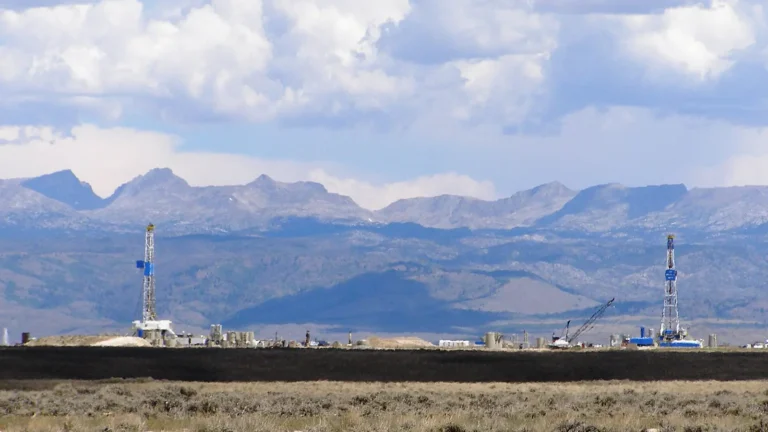
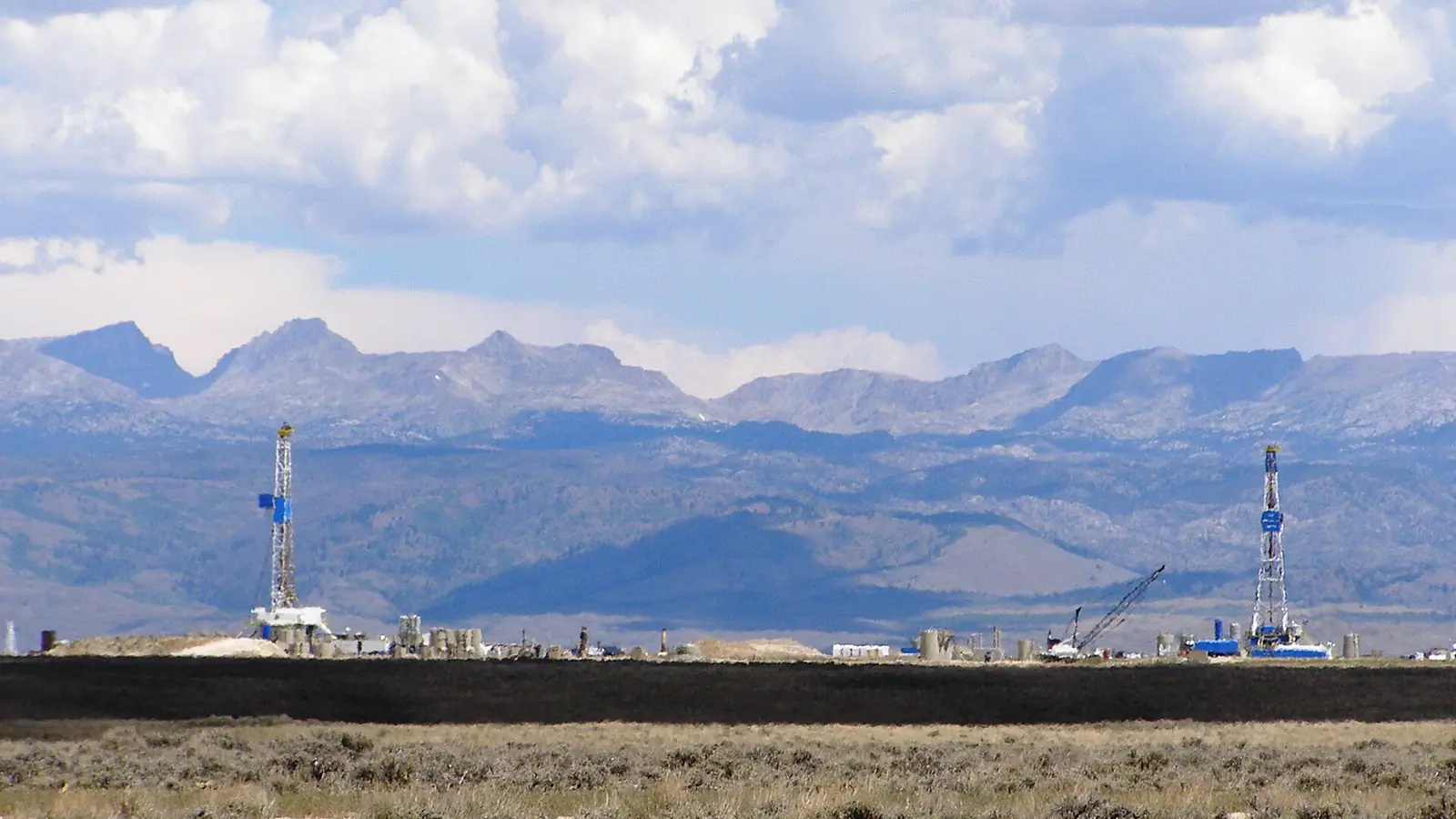
Pinedale and Jonah produce from the Lance formation, tight sandstones that give up gas slowly. Individual wells are modest but long-lived, and there are thousands of them. PureWest Energy, Ultra Petroleum’s successor on the Pinedale Anticline, describes more than 108,000 net mineral acres and over 3,400 operated wells; Jonah Energy operates the Jonah field to the south. Both are private, so neither publishes reserve reports.
The public record does show how little new drilling there is: 89 Sublette wells first reported production in 2025 and only 29 in the reported months of 2026, against roughly 7,100 already producing. The drilling that would change that is stalled: on January 15, 2026 the Interior Board of Land Appeals vacated the Bureau of Land Management’s 2018 Record of Decision for the Normally Pressured Lance project — the proposed 3,500-well expansion west and south of Jonah — finding the air-quality conformity analysis defective for excluding emissions from portable drilling rigs. Interior Secretary Doug Burgum’s office took jurisdiction and stayed that decision on February 12, 2026, and Governor Mark Gordon petitioned for reversal the same month. No final decision has been published since.
Jonah Energy’s vice president has said the field has “maybe a handful of years of drilling inventory” left before the company pivots to that acreage. Meanwhile Jonah has announced four acquisitions since January 2025 — in the New Mexico Permian, the South Texas Eagle Ford and the western Anadarko Basin among them. None are in Wyoming. Price the tail you can see, not an expansion still under appeal.
The Madison Side: A Royalty on Gas That Is Mostly Not Gas
Fogarty Creek and Lake Ridge sit on the LaBarge Platform, where ExxonMobil produces from the Madison, a carbonate reservoir about 900 feet thick at roughly 14,000 to 18,000 feet. The wells are enormous, and what they produce is unlike anything else sold as gas in Wyoming. In ExxonMobil’s own monitoring plan filed with the Environmental Protection Agency, average Madison gas is about 21 percent methane, 66 percent carbon dioxide, 7 percent nitrogen, 5 percent hydrogen sulfide and 0.6 percent helium.
That composition is the whole valuation story on this side of the county. About four-fifths of the produced volume is not salable methane. It is separated at the Shute Creek treating facility in neighboring Lincoln County, where the carbon dioxide is sold mainly for enhanced oil recovery, the helium is recovered for sale, and the hydrogen sulfide is stripped and injected for disposal. A decimal applied to a raw Madison volume and the same decimal on a Lance well are not measuring the same commodity, and the lease language deciding what you are paid on — methane only, or the carbon dioxide and helium too — matters far more here than at Pinedale.
One caution: Fogarty Creek, Lake Ridge and the adjoining Graphite unit are federal units inside the Bridger-Teton National Forest, and ExxonMobil is the sole federal lessee in two of the three. Private fee minerals are scarce there, so a Sublette owner is far more likely on the Pinedale or Jonah side.

Produced Volume Is Not Sold Volume
The WOGCC keeps two sets of county numbers, and the gap between them is worth a Sublette owner’s attention. In 2025 the county reported 608.7 Bcf produced but 501.6 Bcf sold — about 107 Bcf, roughly 18 percent, that never reached a sales meter. Royalty is calculated on what is sold and valued, not on what a well is credited with producing.
Wyoming gives you tools to audit that. The Royalty Payment Act requires the check stub to show volume, price, taxes and itemized deductions (W.S. 30-5-305(b)), and in Cabot Oil & Gas Corp. v. Followill, 2004 WY 80, the Wyoming Supreme Court held royalty is free of the costs of production unless a written agreement says otherwise. Where value is fixed is genuinely contested here: in Exxon Mobil Corp. v. Wyoming Department of Revenue, 2011 WY 161, 266 P.3d 944, the court held the LaBarge well-site meters were not “custody transfer meters” under W.S. 39-14-203(b)(iv) for ExxonMobil’s own gas, because ExxonMobil held custody on both sides of the meter. That was a severance tax case, but the underlying question — where production ends and processing begins — drives post-production deductions too. Our guide to reading an oil and gas royalty statement covers the line items.
Federal, State or Fee — Confirm It First
Roughly three-quarters of Wyoming’s gas comes off federal leases, and Sublette is part of the reason. Federal minerals cannot be sold by a private owner, so the first question is whether the interest in your family’s paperwork is a fee mineral interest, a federal lease interest, or only a surface tract over someone else’s minerals. Recorded instruments are held by the Sublette County Clerk at 21 South Tyler Avenue in Pinedale, which publishes a searchable land records index online.
One worry you can set down: Wyoming has no dormant mineral act, and the Marketable Title Act does not reach severed minerals, so an interest here is not lost because nobody used it. The real risks to a long-idle interest are unpaid county taxes on the severed estate and broken chains of title among heirs — both cheaper to fix before a sale than during one.
What Moves the Number From Here
An interest with little drilling ahead of it is priced off two things: how long existing wells keep producing, and what the gas sells for. The Energy Information Administration’s October 2026 Short-Term Energy Outlook puts Henry Hub at $3.16 per million British thermal units in 2027, down about 9 percent from 2026 — while noting January 2026 averaged $7.72 after winter storm Fern. That spread is the honest answer to anyone quoting a single forward price.
Taxes come off the top: severance is 6 percent on oil and gas, and royalty owners bear their share of the county ad valorem tax on production, which averaged about 64 mills statewide in 2024. There is no state income tax, though federal tax applies to royalty income and sale proceeds. The one new demand-side development is local — on May 6, 2025 PureWest, Prometheus Hyperscale and Frontier announced a plan to supply a data center campus at Evanston, with PureWest initially providing up to 200,000 MMBtu per day. It is an announced plan, not a contracted volume, and should be weighed as such.
When Holding Beats Selling
A long, flat production tail is a real asset for an owner who wants income and has no near-term need for cash. Lance wells decline slowly, and a working Sublette royalty can pay modestly for a very long time. Selling tends to make more sense when an interest has been split among heirs into fractions too small to administer, when an out-of-state owner cannot police deductions, or when the value quoted depends on drilling that may never be permitted. In Sublette that last one is live, not hypothetical.
The same questions land differently elsewhere. Just south, a Sweetwater County mineral rights interest sits in the same Green River Basin with the same tight-gas and regional-pricing exposure, but without the deep sour-gas half of the equation. The closest Wyoming analogue to the LaBarge Madison is in Fremont County mineral rights, where the Madden field’s deep Madison wells also produce a sour, carbon-dioxide-rich stream needing treatment at a dedicated plant — the same reason a headline volume there overstates what a royalty is paid on.
There is no credible per-acre figure for this county: a non-producing tract, a Lance royalty and a LaBarge interest are three different assets. A serious offer rests on your legal description, your decimal, the field and formation your wells produce from, and a recent check stub. Start with our Sublette County mineral rights page, which has a form to send those details securely. You can also read how to sell Wyoming mineral rights statewide, or contact us directly.
Sources: Wyoming Oil and Gas Conservation Commission, production and sales by county by year (well-level 2024-2026 files, summed by field, retrieved October 2026; 2026 figures preliminary) and Supervisor Report, March 2026; ExxonMobil Shute Creek Treating Facility Subpart RR MRV Plan (U.S. EPA); Interior Board of Land Appeals decision of January 15, 2026 vacating the BLM Normally Pressured Lance Record of Decision, with subsequent Interior and Wyoming filings as reported by WyoFile and Cowboy State Daily; Jonah Energy LLC announcements, 2025-2026; PureWest Energy company materials; U.S. Energy Information Administration, Short-Term Energy Outlook, October 2026; W.S. 30-5-305 and 39-14-203(b)(iv); Cabot Oil & Gas Corp. v. Followill, 2004 WY 80; Exxon Mobil Corp. v. Wyoming Department of Revenue, 2011 WY 161, 266 P.3d 944. This article is general information, not legal or tax advice.
Photos: Theo Stein / USFWS / Wikimedia Commons, CC BY 2.0; Bureau of Land Management Wyoming / Wikimedia Commons, public domain; Tony Webster / Wikimedia Commons, CC BY-SA 4.0; Bob Wick, Bureau of Land Management / Wikimedia Commons, public domain.
MINERAL RIGHTS & ROYALTIES
Ready to explore an offer for your mineral rights?
Tell us a little about your interest. Get a free, no-obligation review from Selling My Mineral Rights.